
Why Spending The Value Of Your Car On Suspension Isn't Actually About The Car
Why Spending The Value Of Your Car On Suspension Isn't Actually About The Car...
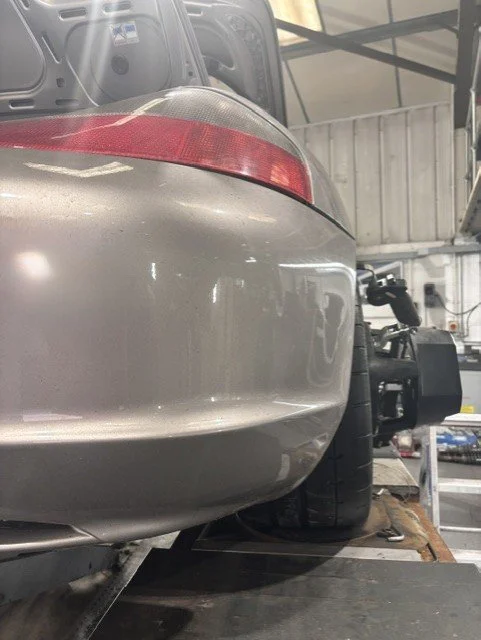
A £6,000 Boxster. Ten years of track use. More suspension development than many would consider sensible. Yet perhaps that's missing the point entirely.
There's a strange contradiction in track day culture.
People will spend six figures on a GT product, worry endlessly about stone chips, brake wear and depreciation, then look sideways at someone spending proper money developing a "cheap" track car.
But the reality is often the opposite - as some would argue, some of the best driving experiences come from the cars that owe you very little — financially, emotionally or reputationally.
Take this 986 Boxster S. Not rare (albeit you could argue about the colour). Not especially valuable.
Certainly not what most people would consider an investment. On a good day, it's probably a £6,000 car.
Yet this particular Boxster has survived more than a decade of hard circuit use. Proper use. Not occasional parade laps and coffee meets. Real mileage, real abuse and real learning with next to no mechanical demands or faults. In the last ten years alone, it has covered around 10,000 track miles. Anyone who spends time on circuit knows those miles count differently. Realistically, that's the equivalent of somewhere approaching 100,000 miles of hard road use in terms of load cycles, wear and experience.
That's 100,000 miles of pure enjoyment.
What's interesting about this car is that it has never been about throwing a huge budget at it from day one. It's been iterative, real-world 'drive by the seat of your pants' development.
Phase one started simply with geometry
Learning the car. Understanding its strengths and weaknesses. Improving balance before chasing hardware.
Then came coilovers, cheap ones too - in fact, we openly scoffed at them ourselves when they first appeared. Unknown quality. Budget price point. All the usual assumptions came with them. But then something rather annoying happened. They worked, and more importantly, they kept working. Those dampers have effectively survived the track equivalent of more than 75,000 miles, enduring years of circuit abuse that many far more expensive setups never experience.
That alone says plenty.
As confidence and pace increased, the car evolved alongside the driver.
Stickier tyres demanded more front-end grip and support, leading to increased camber figures through adjustable track control arms. Increased grip then highlighted body control limitations, leading to adjustable anti-roll bars to better manage roll stiffness and platform control. And when the roll can no longer be controlled? We pivot to a new solution.
Each modification revealed the next opportunity. Not because the internet said so, but because the car was being genuinely used.
And perhaps that's where cars like this are so often misunderstood.
Looking at the finished product today, it's easy to focus on what the car is worth. The reality is that the value isn't in the car itself. It's in ten years of learning, experimentation and enjoyment that have shaped it into what it is today.
Which brings us back to a familiar track day phenomenon. We've experienced it ourselves over the years. Maybe it's imagined.
But is it?
The sideways glance at the cheaper car. The assumption that the non-GT car is somehow the lesser thing in the paddock. That enjoyment, capability or driver satisfaction must somehow correlate directly to value. However, usually, it doesn't...
Because after a few sessions, the cars getting properly driven — and the drivers wearing the biggest smiles — often aren't the most expensive ones there.
Now we arrive at what is effectively phase three of this car's track life - and with it proper financial investment: Öhlins, Yokohama A052s and a healthy dose of camber.
A chassis setup designed around a driver who now understands exactly what they want from the car. And that's the important bit, this isn't modification for modification's sake, it's development built on years of feedback, learning and seat time.
There's also an argument — one many experienced drivers quietly agree with — that slower, simpler cars demand more technical skill.
A modern GT Porsche is astonishing. The capability is immense. But they can also mask imperfections, allowing drivers to rely on the car's capability rather than technique. A lightweight, lower-powered chassis doesn't flatter you in quite the same way. You have to work for lap time, to understand weight transfer and momentum.
You have to understand what the car is doing underneath you, and when you get it right, it's deeply satisfying.
Sometimes the easiest route is simply to buy a faster car, and there's nothing wrong with that. However, a faster car doesn't always make you a faster driver. Often it's the modestly powered, slightly scruffy, heavily used track car that teaches the biggest lessons - they force us to chase tenths through technique rather than horsepower. And that's where many drivers discover the real enjoyment lies.
Thankfully, this particular owner gets to enjoy both ends of the spectrum. Alongside the Boxster sits a 991 Turbo S. Devastatingly fast, hugely capable and a completely different animal altogether - but neither replaces the other. If you asked which was his favourite? He'd be hard pushed to decide.
One rewards precision, momentum and commitment and the other delivers effortless speed and devastating cross-country pace.
Different tools. Different challenges. Different experiences. Both brilliant in their own way.
That's why cars like this 986 Boxster S (or say similarly, the S2000, MX5's and such) continue to be the unsung heroes of the track day world. Not because they're fashionable or valuable, but because they're honest - with no theatre, or ego attached - just seat times, development and enjoyment. Ironically, a £6,000 suspension bill on a £6,000 car raises eyebrows, but a £6,000 depreciation hit on a newer one barely gets a mention.
The difference is that one creates experience and the other protects an asset. And perhaps that's the real point: some cars are investments, some are tools. The very best track cars often become both.
How we can help
Whether you're refreshing a fast-road car or building a dedicated track machine over several years, we believe the best suspension development is always driven by real-world feedback rather than chasing a specification sheet.
If you're planning your next stage of development, we'd be happy to discuss your objectives and help you build a package that evolves with both the car and the driver.