
Would You Like Extra Camber With That?
Why the answer isn't always another degree of negative camber
Spend enough time around track cars and you'll hear the same solution offered time and time again:
"It needs more camber."
Sometimes that's true. Often, however, it's only treating the symptom rather than addressing the cause.
The photo below is a good example. At first glance, many would immediately conclude the tyre needs more negative camber. After all, the outer shoulder appears to be doing a lot of work.
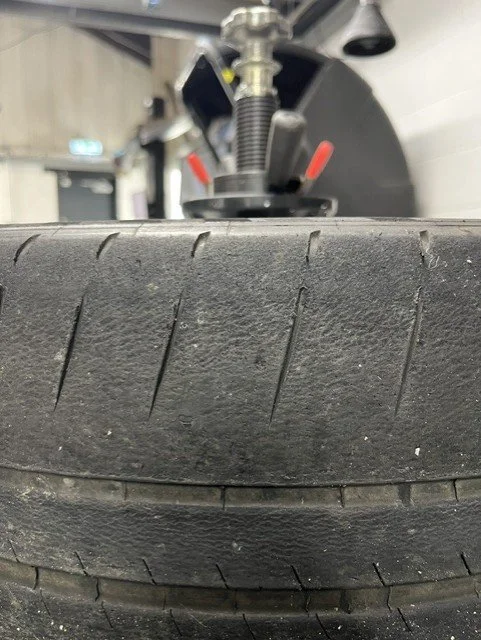
But tyre wear patterns only tell part of the story.
What is actually happening?
A tyre doesn't know what static alignment settings are on the ramp, it only knows the loads being applied to it while the car is moving. When a car corners, the body rolls. As the body rolls, the tyre can end up falling over onto its outer shoulder. The more the chassis rolls, the more the tyre is forced away from its ideal contact patch.
The common response is to add more negative camber.
That may improve things temporarily by repositioning the tyre at rest, but if excessive body roll remains, the car will simply continue to roll onto the outside shoulder under load.
You've moved the starting point, but you haven't solved the problem.
Camber isn't a substitute for body control
Think of camber as a tuning tool, not a cure-all.
If the platform lacks support, adding more and more negative camber can become a sticking plaster.
The real issue may be:
Spring rates that are too soft
Anti-roll bar settings that aren't controlling roll effectively
Dampers that aren't providing sufficient platform support
Ride heights that have altered suspension geometry
A combination of all of the above
In these situations, continually chasing larger camber numbers can create compromises elsewhere.
The missing part of the camber conversation
There is another factor that's often overlooked:
Not all tyres want the same amount of camber.
A setting that works brilliantly for one tyre can be completely wrong for another.
Tyre construction varies enormously between manufacturers and even between products within the same range. Sidewall stiffness, carcass design, tread profile and operating temperature all influence how much camber a tyre requires to generate grip efficiently.
Michelin for instance, quote the following in respect of their Cup 2 tyre for a 991 GT3:
GEOMETRICAL SETTINGS (E.G., CAMBER/TOE)
On the track, geometry settings (camber primarily) can be modified to improve cornering speeds and grip through maximising tyres' footprint and also to prevent excessive wear/fatigue to the outer shoulder.
Camber: for optimal results on a track, the negative camber settings should be between -1.5° & -3° dependent upon the track and the type of vehicle. Never exceed -4° of negative camber.
Camber values for road use must be based upon the recommended « road » settings to ensure the correct handling and behaviour for both the vehicle and the tyres.
A tyre with a very stiff sidewall may require comparatively little negative camber because it naturally resists deformation under load. A softer construction may benefit from additional support through alignment and suspension settings.
This is one reason why copying another driver's geometry settings can be so disappointing. Two seemingly identical cars running different tyres may require completely different alignment strategies.
So, we treat the tyre as part of the suspension system. Treating camber as a fixed number without considering the tyre itself is only looking at half the picture.
The hidden cost of chasing camber
Excessive negative camber doesn't come for free, and adding more won’t automatically translate into handling improvement.
Too much negative camber can:
Reduce braking stability
Reduce traction when accelerating
Make the car nervous on uneven roads
Increase inner shoulder tyre wear
Reduce driver confidence
And confidence matters, as we know that a driver who trusts their car will almost always be quicker than one who doesn't. We've seen cars arrive with aggressive alignment settings that look impressive on paper, yet the driver struggles to exploit the available grip because the car feels nervous, inconsistent, or simply harder to place accurately.
Lap times rarely reward alignment numbers alone.
Looking beyond the alignment screen
One of the biggest mistakes in chassis tuning is viewing alignment settings in isolation.
The tyre is simply the final link in a chain.
If the chassis isn't supporting the tyre correctly, changing camber may only mask what's happening further upstream.
Before reaching for more negative camber, it's worth asking:
Why is the tyre working so hard on the outer shoulder in the first place?
The answer may not be found in the alignment settings at all.
Our approach
This is why we spend so much time evaluating the entire vehicle rather than chasing a particular number.
The goal isn't maximum camber. The goal is maximum confidence, maximum tyre performance, and maximum consistency for the way the car is actually used. The correct camber setting depends on the vehicle, the suspension package, the amount of roll being generated, the driver's objectives, and even the tyre fitted to the car.
Sometimes the answer is more camber. Sometimes it's less.
Often, the real improvement comes from increasing roll support and allowing the tyre to work in a more favourable operating window. Because ultimately, tyres don't perform based on what the alignment printout says. They can only perform when the chassis allows them to do their job.
How we can help
Whether you're trying to optimise a dedicated track car or simply want more confidence from your road car, suspension tuning is rarely about chasing a single alignment figure. We assess the complete chassis, from the tyres and suspension package to the way the car is driven, before recommending a setup that's right for you.
If you're considering changes to your suspension or alignment, we'd be happy to discuss your requirements and help you choose the most appropriate route for your car.